

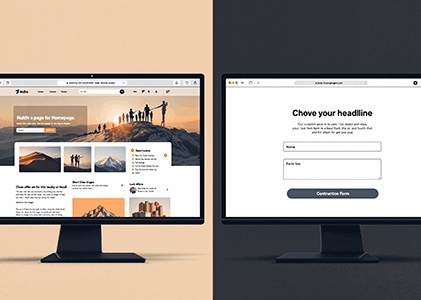
The Difference Between a Landing Page and a Website
 If you’ve spent any time in the digital marketing world, you’ve probably heard the terms website and landing page tossed around a lot. Sometimes people use them interchangeably, but here’s the truth: they are not the same thing. In fact, understanding the difference between a website and a landing page can change how you approach your marketing, how you spend your time, and how you connect with your audience.
When I talk to small business owners, this is one of the biggest lightbulb moments they have. They’ll say something like, “Ohhh, I thought a landing page was just a single-page website,” or, “Wait, I don’t actually need a whole new website for this promotion?” Once you understand how each one works — and when to use them — it becomes easy peasy to choose the right tool for the right job.
Let’s break it down.
What Is a Website?
Think of your website as your digital home base. It’s the main hub of your online presence, the place where people go to learn more about you, your services, and your brand.
A website usually has multiple pages — a Home page, About page, Services or Products page, Blog, and Contact page at the very least. It’s designed to give visitors the big picture of who you are and what you offer. Your website is meant to be a long-term investment, something you maintain and update as your business grows.
Some key features of a website:
-
Multiple pages with structured navigation.
-
Information about your business, your story, and your services.
-
Blog posts or resources for ongoing visibility.
-
A way for customers to contact you or buy from you.
-
A professional design that builds trust and credibility.
In short, your website is about painting a full picture of your brand. It’s like a storefront, brochure, and business card all rolled into one.
What Is a Landing Page?
Now let’s talk about landing pages. A landing page is much more specific and focused. Instead of being a hub for all your information, it’s designed to guide visitors toward one very clear action.
Landing pages are often used for:
-
Collecting email addresses with a lead magnet.
-
Promoting a specific product or service.
-
Driving sign-ups for an event or webinar.
-
Running ads that point to a single offer.
Unlike a website, a landing page usually has no navigation menu. That’s on purpose — because you don’t want visitors clicking away or getting distracted. The goal is to focus their attention on one thing: signing up, buying, or booking.
Some key features of a landing page:
-
One page with a single purpose.
-
A strong headline and clear call-to-action (CTA).
-
Minimal distractions (no menus, no extra links).
-
Content written specifically for the offer.
-
A form or button that leads to the next step.
A landing page is less like your digital home and more like a pop-up shop. It’s built for a specific purpose and often for a specific campaign.
The Key Differences
Here’s a simple way to think about it:
-
A website = broad, general, and built to tell your whole story.
-
A landing page = narrow, specific, and built to drive one action.
Websites are ongoing, while landing pages are often temporary or campaign-based. Websites are built for exploration, while landing pages are built for conversion. Both are important, but they serve very different purposes.
When You Need a Website
Every business needs a website. Period. Even if you’re super active on social media, those platforms are rented space. Algorithms change, accounts can get hacked, and trends come and go. Your website is digital real estate that you own — and it’s one of the few things that gives you long-term stability online.
You need a website if:
-
You want to build credibility.
-
You want a central hub for your brand.
-
You need a place to showcase your full range of services or products.
-
You want to publish blogs or resources for SEO.
-
You want people to easily find and contact you.
Great platforms for building websites include:
-
Squarespace – user-friendly and all-in-one.
-
WordPress – flexible and powerful if you want customization. (This website is built on WordPress)
-
Wix – approachable for beginners.
-
Shopify – excellent for e-commerce.
Your website is a long-term investment. It’s the place you’ll send people over and over again.
When You Need a Landing Page
Landing pages shine when you have something specific to promote. They’re especially effective for ads, email campaigns, or product launches because they cut out the noise and give people one option: take the action or leave.
You need a landing page if:
-
You’re running a Facebook or Google ad campaign.
-
You want to grow your email list with a freebie.
-
You’re launching a new product or service.
-
You’re promoting a webinar, challenge, or event.
Great tools for landing pages include:
-
ConvertKit – simple and built for creators.
-
Leadpages – affordable and powerful for small businesses.
-
ClickFunnels – robust for building funnels.
A landing page is about focus. It removes distractions and makes it crystal clear what you want your audience to do.
How Websites and Landing Pages Work Together
Here’s where it gets fun: websites and landing pages aren’t competitors. They actually work beautifully together.
For example:
-
Your website tells the big-picture story of your business.
-
Your blog posts (on your website) bring in organic traffic.
-
Your landing page captures that traffic and grows your email list.
-
Your email marketing then builds the relationship and drives sales.
Think of your website as the foundation and your landing pages as the tools you use to build specific extensions or campaigns. One is your home base, and the other is your marketing playmaker.
Common Mistakes to Avoid
When small businesses confuse websites and landing pages, they run into problems like:
-
Using a homepage as a landing page (too many distractions).
-
Building a landing page when they really need a full website.
-
Forgetting to link landing pages back to their main website. This is a big one!
-
Spending all their time on landing pages without investing in a website foundation.
The fix? Know the difference, use each one for its intended purpose, and make sure they complement each other instead of competing.
The Bottom Line
Websites and landing pages are both essential tools, but they do different jobs. Your website is your digital home, your foundation, and your long-term investment. Your landing page is your campaign powerhouse, designed to capture attention and drive specific actions.
When you understand the difference, you stop wasting time and money building the wrong thing — and start creating digital spaces that actually work for your business.
How I Can Help Small Businesses
I help small business owners cut through the overwhelm and create both websites and landing pages that truly work. Whether you need a polished digital home base, a high-converting landing page, or a strategy that connects the two, I make it simple and approachable. If you’re ready to build a website or landing page (or both) that actually moves the needle, I’d love to be your partner in making it happen.